In the printmaking world (and probably the art world in general), scarcity is this thing that gets people excited. Scarcity creates value. This is why printmakers edition their works, because it creates value, it creates exclusivity. It tells the buyer: You are special, because there are very few people like you. Scarcity as a concept seems simple enough, I guess: It just means there are a limited number of a thing. But there’s a lot of ways that limitation can come about.
In traditional printmaking techniques, the printing plate (or “matrix”) wears down with every print, eventually reaching a point where the resulting prints are of unacceptable quality. With more modern techniques like linocut (where the plate is so durable it basically doesn't wear out) or giclée printing (which is a precise inkjet print from a digital file), scarcity is the result of a deliberate choice on the artists' part, to set an artificial limit (or not! One can also make an open edition in which there is no implied scarcity at all.).
Naturally, digital art is the opposite of scarce, you can make as many copies of a computer file as you like. NFTs were meant to create a blockchain-enforced scarcity of digital media, whereby “ownership” of an otherwise freely copiable file was enforced by a psuedo-legal framework that you opted into. Of course it was still backed by a digital file, so that agreement didn’t really count for much, and a lot of people lost a lot of money because they didn’t understand that basic fact, and the NFT market collapsed once they did. Suckers.
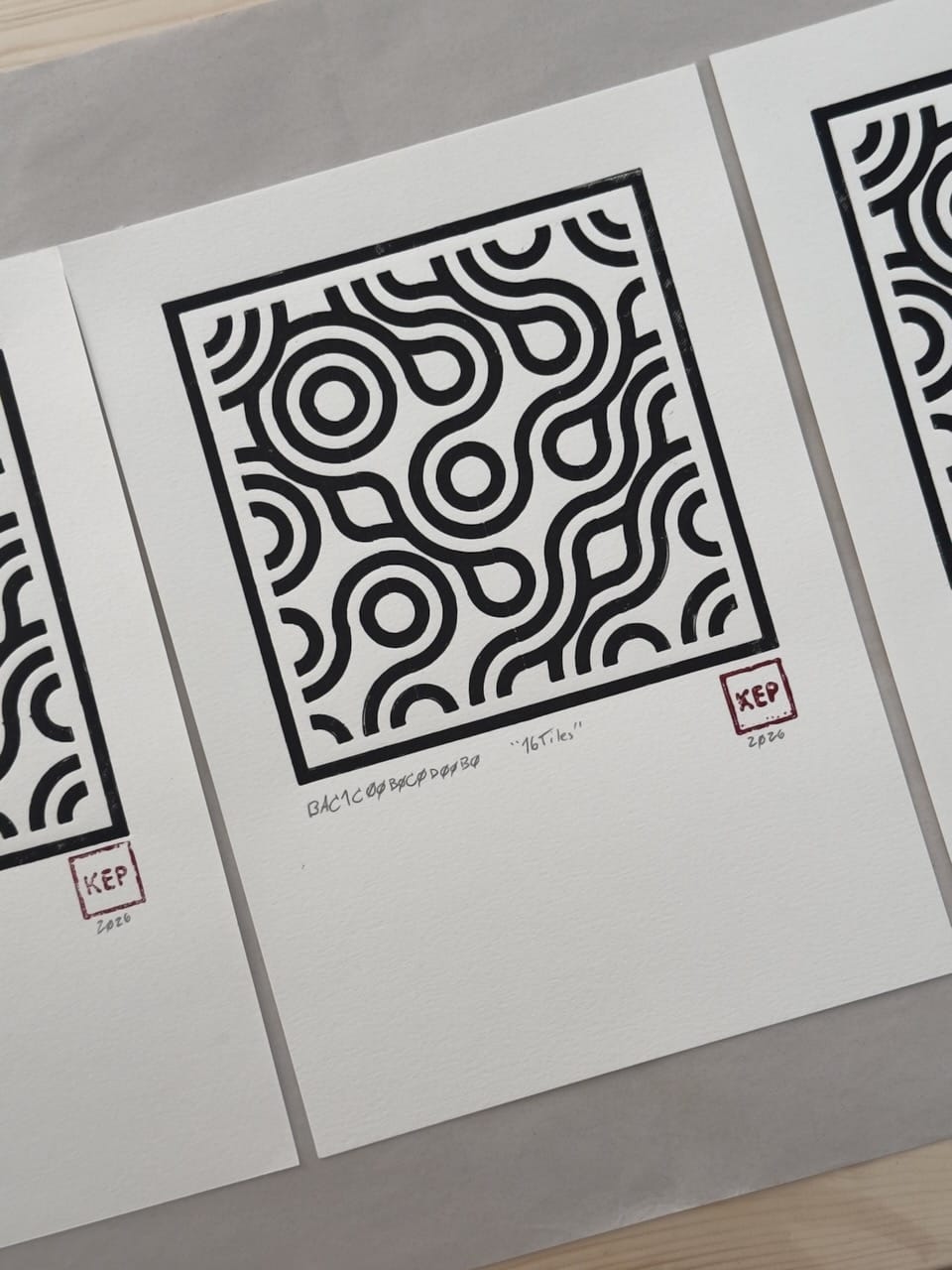
My series “16 Tiles” explores the use of tiling to generate patterns. With the two tiles I designed, placing them in a 4x4 grid means there are over 2.8 trillion possible configurations. This hardly seems scarce. You can bop over to this page and explore the space just as fast as you can click “randomize”. But at the same time, each configuration is unique in that space, there is no repetition. So, my work plays with the idea of scarcity, and asks—much like the people pushing NFTs asked—can we make something limited from an inexhaustible resource? And what are the constraints necessary for us to achieve that?
This work presents one approach. What makes the prints in this series scarce isn’t wear (the tiles I made are indestructible and trivially reproducible), it isn’t arbitrary decision making, it isn’t an unnatural reliance on artificial (and unenforceable, and frankly silly) contracts. It’s playfulness. Making prints with ink and paper is a form of play. Exploring the space of possibilities, laying out the tiles and seeing what happens, making mistakes and trying again, enjoying the imperfections of the process, these are all forms of play. “16 Tiles” is ultimately a piece about exploring a nearly infinite space, about discovery and serendipity. And that’s why I choose to only ever print any given configuration once, because printing it twice ceases to be an act of playful exploration, it just becomes commercial and frankly boring.
Each print is made from matrices conceptualized in Affinity, and realized in PETG on a Bambu Labs P2S 3D printer, stamped and assigned a serial number that uniquely identifies the specific tile configuration used to make it. They are printed on Winsor & Newton 220g/m² A4 paper with Charbonnel oil-based relief printing inks. You can purchase your own unique print at the KEP Shop.